




Iceland’s Essential Day Trip
The Golden Circle is a 300-kilometre loop from Reykjavik covering three of Iceland’s most significant natural sites — Þingvellir (Thingvellir) National Park, the Geysir geothermal area, and Gullfoss waterfall. The circuit takes approximately 6–8 hours by road and is the most popular day tour in Iceland, visited by the majority of the country’s 2+ million annual tourists. The three sites are geologically, historically, and visually distinct, and the loop format returns you to Reykjavik by evening.
The Three Sites
Þingvellir National Park is where the North American and Eurasian tectonic plates are pulling apart — a rift valley visible at the surface as a dramatic fissure in the landscape, with the Almannagjá gorge marking the edge of the North American plate. Þingvellir is also the site of the Alþingi — the Icelandic parliament founded in 930 AD, one of the oldest parliamentary institutions in the world. The combination of geological drama (you walk between two continental plates) and historical significance (the founding site of Icelandic democracy) makes Þingvellir a UNESCO World Heritage Site.
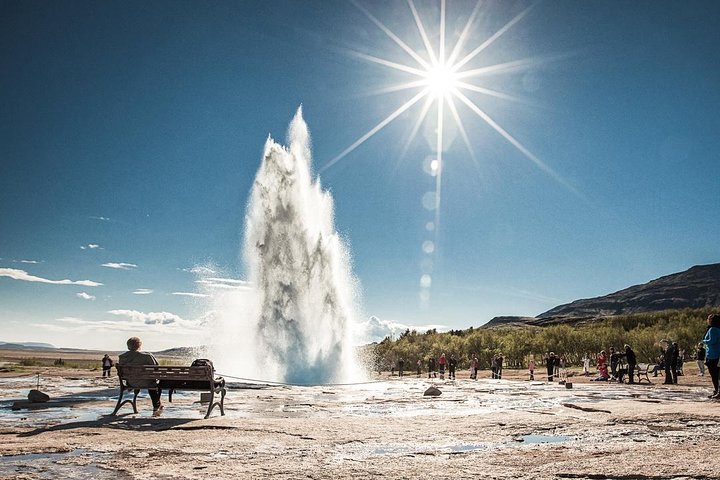
Geysir is the original geyser — the geothermal area that gave the word “geyser” to every language. The Great Geysir itself is largely dormant, but Strokkur (its neighbour) erupts every 5–10 minutes, sending a column of boiling water 15–30 metres into the air. The surrounding geothermal field includes fumaroles, hot springs, and bubbling mud pools — the surface expression of the volcanic activity beneath Iceland.
Gullfoss (Golden Falls) is a two-tiered waterfall where the Hvítá river drops 32 metres into a narrow canyon in two dramatic stages. The volume of water (approximately 140 cubic metres per second in summer) and the canyon setting create a wall of spray and sound. In winter, the falls partially freeze, creating ice formations around the cascading water. A path leads to a viewpoint at the canyon’s edge — close enough to feel the spray.
Practical Tips
The Golden Circle is accessible year-round. Summer (June–August) has 20+ hours of daylight and the warmest temperatures (10–15°C). Winter (November–February) has limited daylight (4–6 hours) but the possibility of northern lights and the dramatic frozen landscape.
The roads are paved and well-maintained. The Golden Circle follows Route 36, Route 35, and Route 37 — all paved, all suitable for standard rental cars in summer. In winter, conditions can include ice and snow — a 4WD or a guided tour with an experienced driver is recommended.
Dress for Icelandic weather regardless of season. Wind, rain, and sudden temperature changes are constant. Layered clothing with a waterproof, windproof outer shell is essential. The spray at Gullfoss will soak anyone standing at the lower viewpoint without waterproofs.
Combine with Silfra or the Secret Lagoon. Many Golden Circle tours add a snorkelling session at Silfra (in Þingvellir, between the tectonic plates — covered separately) or a soak at the Secret Lagoon (Flúðir, a natural hot spring near Geysir) for a more complete day.
Frequently Asked Questions
How long is the Golden Circle tour?
Typically 6–8 hours from Reykjavik. Self-driving allows flexible timing. Guided tours depart at approximately 8:00–9:00 AM and return by 4:00–6:00 PM.
Can I drive the Golden Circle myself?
Yes — the route is straightforward, the roads are paved, and the sites are well-signposted. Self-driving provides flexibility on timing. A guided tour adds the geological and historical narration that the sites’ information boards do not fully cover.
How much does a Golden Circle tour cost?
Guided tours: approximately 8,000–15,000 ISK ($55–105 USD) per person. Self-driving: free (fuel and car rental costs only). Site entry: Þingvellir parking fee (approximately 750 ISK); Geysir and Gullfoss are free.
Is the Golden Circle worth it if I only have one day in Iceland?
Yes — if you have a single day, the Golden Circle is the standard recommendation. It covers the tectonic geology, the geothermal activity, and the waterfall scenery that define Iceland’s landscape in one efficient loop.
When is the best time to visit the Golden Circle?
Summer for the warmest weather and longest daylight. Winter for the frozen landscape, the northern lights possibility, and the dramatic low-angle Arctic light. The Golden Circle is compelling in any season.